missing translation for 'onlineSavingsMsg'
Learn More
Learn More
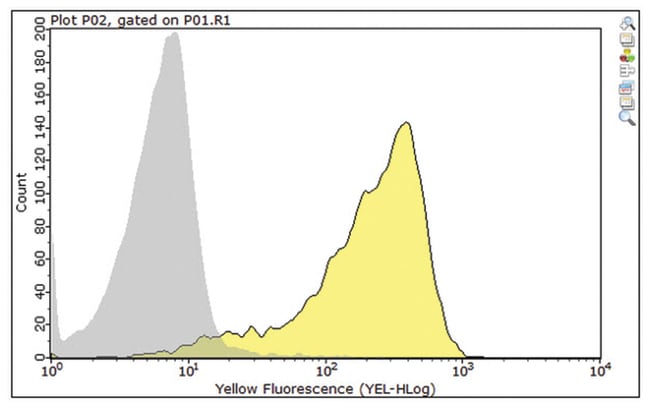
MilliporeSigma™ H-2K, Mouse, Unlabeled, Clone: Y-3,
Mouse Monoclonal Antibody
Supplier: MilliporeSigma™ MABF946
Description
Major histocompatibility complexes (MHCs) are cell surface molecules that play a major part of the immune system in all vertebrates by determining histocompatibility. The main function of MHCs is to bind and present peptide fragments derived from pathogens on the surface of antigen presenting cells. MHCs are divided into two major classes, class I MHCs are heterodimers composed of a transmembrane alpha chain and a common extracellular beta subunit. The alpha chain contains three domains (alpha1, alpha2, and alpha3), with the alpha1 domain mediating interaction with the beta2 subunit. The alpha1 and alpha2 domains form the antigen-binding groove. Class II MHCs are heterodimers of two single transmembrane chains, alpha and beta, each contains two domains, with the N-terminal alpha1 and beta1 domain from each chain forming the antigen-binding groove. Murine class I MHC is further divided into the classical H-2D, H-2K and H-2L subclasses, and the non-classical H-2Q, H-2M and H-2T subclasses. MHC molecules are highly polymorphic and laboratory mouse strains are homozygous with respect to their respective MHC haplotypes. The haplotype of each H-2K, for example, is specified by a lower case letter (b, d, k, q, r, s) in superscript. MHC class I molecules are ligands for the antigen receptors of CD8+ T cells and NK cells. MHC class I antigenic peptides assembly takes place within the endoplasmic reticulum (ER) and are facilitated by the peptide loading complex (PLC) composed of multiple proteins, including transporter associated with antigen processing (TAP), Tapasin, the thiol oxidoreductase ERp57 and calreticulin (CRT).Specifications
| H-2K | |
| Monoclonal | |
| Please refer to lot specific datasheet. | |
| Purified mouse IgG2b in PBS without preservatives. | |
| P01901;P04223;P14428;P01887 | |
| BALB.B mouse spleen cells. | |
| 100 μg | |
| Inflammation & Immunology | |
| NP_001001892;NP_033865 | |
| Mouse | |
| Purified |
| Flow Cytometry, Functional Assay, Immunocytochemistry, Immunoprecipitation | |
| Y-3 | |
| Unconjugated | |
| H2-K1, H2-K, B2m | |
| Mouse | |
| Protein G Purified | |
| RUO | |
| Primary | |
| Clone Y-3 was isolated from a BALB/c (H-2 haplotype d) mouse immunized with Con A-stimulated murine spleen cells from the BALB.B (H-2 haplotype b) strain and originally referred to as anti-H-2.5. Clone Y-3 is reported to recognize murine class I MHC subclass H-2K haplotypes b, k, q, r, s, but not d (Hammerling, G.J., et al. (1982). Proc. Natl. Acad. Sci. U. S. A. 79(15):4737-4741; Jone, B., and Janeway, C.A. Jr. (1981). Nature. 292(5823):547-549). | |
| Stable for 1 year at -20°C from date of receipt. Handling Recommendations: Upon receipt and prior to removing the cap, centrifuge the vial and gently mix the solution. Aliquot into microcentrifuge tubes and store at -20°C. Avoid repeated freeze/thaw cycles, which may damage IgG and affect product performance. | |
| IgG2b κ |
For Research Use Only. Not for use in diagnostic procedures.